Succession is the idea of the sorts of plants and animals in a habitat changing over time. There are two types: primary succession occurs when there is a totally bare piece of land, like a rock or somewhere that has been wiped out by a volcanic eruption.
Pioneer species are the first living things to grow on the land, they are renowned for being able to withstand tough and extreme conditions that other plants cannot live in. Often they get there because they have spores or windblown seeds which are easily transported from other communities. Once there they reproduce rapidly, as this is often a feature of pioneer species. The plants will photosynthesise to produce energy, they may also produce nitrogen by bacteria on their root nodules as there will be little existing nutrient in the soil.
When the plants from the pioneer species die and decompose, they leave deposits of nutrients; the beginnings of soil. This soil is rich in humus (organic matter) which other plants need to survive, this means that other species can begin to grow. These plants then decompose in turn increasing the humus even further, and the depth of soil, so new species can move in that are less hardy and have bigger roots. This cycle continues: often the original species are out competed by newer ones; at some point when there are enough plants animals will join the system.
Secondary succession is when a minor disturbance kills off plants, but leaves soil and possibly seeds behind. Here the same process of succession will happen, but as the conditions are less hospitable it does not need a pioneer species to start it off.
The further into succession, the higher the biodiversity as conditions become less hostile and are more friendly to live in for more organisms. Not only is this caused by an improvement in soil, but things like also a decrease in wind, changes in soil acidity and a greater variety of habitats.
We have the idea of a climax community which is the sorts of plants and animals that will grow in an area once it has reached equilibrium. For example, in England, due to the climate, most areas stop changing the species when there is deciduous oak woodland.
Because different plants and animals are suited to different stages of succession, if conservationists are trying to increase the population of a plant or animal, they will control succession to be at the stage that that organism is successful at.
Monday, 29 December 2014
Succession from pioneer species to climax community. At each stage in succession, certain species may be recognised which change the environment so that it becomes more suitable for other species. The changes in the abiotic environment result in a less hostile environment and changing diversity. Conservation of habitats frequently involves management of succession. Candidates should be able to • use their knowledge and understanding to present scientific arguments and ideas relating to the conservation of species and habitats • evaluate evidence and data concerning issues relating to the conservation of species and habitats and consider conflicting evidence • explain how conservation relies on science to inform decision-making.

Sunday, 28 December 2014
The environmental issues arising from the use of fertilisers. Leaching and eutrophication. Candidates should be able to analyse, interpret and evaluate data relating to eutrophication.
Nitrogen is circulated between existence in the atmosphere, in the soil, and in living things. The diagram shows how nitrogen is passed from one form to another.
In plants, animals and decomposers nitrogen exists as ammonium containing molecules like proteins and nucleic acids.
.jpg)
In farming this natural cycle is disrupted because dead matter is removed from the area (as is waste). This means that nitrogen in the soil is not replaced and so fertilizers must be used to replenish levels so that plants can grow there.
Natural fertilisers consist of waste and or dead matter. Artificial fertilisers are made from nitrogen extracted from rocks or made in the harbour process.
Eutrophication happens when water leeches nitrogen from soil and takes it into a water system: here the nitrogen helps algae to grow causing a bloom (large layer of algae); this blocks light for other organisms, like fish, and uses up their oxygen, causing them to die; decomposers increase as they feed on the dead, using up even more oxygen; oxygen is so low that no other organisms can survive.
Nitrogen can leech into supplies of drinking water too.
The role of microorganisms in the carbon and nitrogen cycles in sufficient detail to illustrate the processes of saprobiotic nutrition, ammonification, nitrification, nitrogen fixation and denitrification. (The names of individual species are not required.)
Saprobiotic micro-organisms are ones which get their nutrition from dead matter. They decompose plants and animals, releasing carbon and nitrogen back into the air and soil, helping to make the movement of these molecules a continuous cycle.
Ammonification- creating ammonium from molecules that contain it; done by saprobiotic micro-organisms
Nitrification- turning ammonium into nitrate; this is done by some bacteria to create energy
Nitrogen fixing- turning nitrogen in the air into ammonium; done by free living bacteria to create amino acids for themselves; done by mutualistic bacteria to create amino acids for plants in return for carbohydrates
Denitrification- carried out by bacteria for energy
Nitrifying-bacteria are aerobic and denitrifying-bacteria are anaerobic, so if soil is water logged there will be a decline in nitrification and an increase in denitrification.
Ammonification- creating ammonium from molecules that contain it; done by saprobiotic micro-organisms
Nitrification- turning ammonium into nitrate; this is done by some bacteria to create energy
Nitrogen fixing- turning nitrogen in the air into ammonium; done by free living bacteria to create amino acids for themselves; done by mutualistic bacteria to create amino acids for plants in return for carbohydrates
Denitrification- carried out by bacteria for energy
Nitrifying-bacteria are aerobic and denitrifying-bacteria are anaerobic, so if soil is water logged there will be a decline in nitrification and an increase in denitrification.
The importance of respiration, photosynthesis and human activity in giving rise to short-term fluctuation and long-term change in global carbon dioxide concentration. The roles of carbon dioxide and methane in enhancing the greenhouse effect and bringing about global warming. Candidates should be able to analyse, interpret and evaluate data relating to evidence of global warming and its effects on • the yield of crop plants • the life-cycles and numbers of insect pests • the distribution and numbers of wild animals and plants.
Carbon goes round in a cycle, below is a diagram to show this. The three grey lines, from plants, animals and decomposers, show carbon being put back into the atmosphere by respiration.
.jpg)
Atmospheric levels of carbon dioxide can be changed short term or long term.
A short term change could be brought about by the balance of photosynthesis and respiration: there is more photosynthesis in the day-light which takes CO2 out of the atmosphere and more respiration at night which gives CO2 into the atmosphere.
A long term change may be brought about by a decrease in plants, as they carry out photosynthesis, or a release of carbon from a store. These are both things that humans cause to happen in deforestation and the combustion of wood and fossil fuels.
Light is radiated to the earth by the sun, it is then reflected back off the earth as heat. Gasses in the atmosphere such as CO2 and methane trap heat, so when it is reflected back off the earth it is not lost, but kept and warms our globe. A rise in greenhouse gasses (ones that stop the heat escaping) causes a rise in the temperature of the earth which is global warming.
The potential effects of global warming are wide spread:
Yield
- Certain plants cannot function at high temperatures
- Land may be flooded, leaching nitrogen and increasing denitrifying bacteria
- More energy for reactions (more respiration at night uses up energy stores and decreases yield)
Life cycle
- Change in seasons may disrupt breeding or metamorphosis
- Change in heat may mean some plants or animals miss cues that or based on heat
Distribution
- Warmer temperatures higher up mean that cold loving things are forced to migrate northwards
- More weather extremes and the heat change will mean new selection pressures so different species or characteristics are favoured
Saturday, 27 December 2014
Comparison of natural ecosystems and those based on modern intensive farming in terms of energy input and productivity. Net productivity as defined by the expression Net productivity = Gross productivity – Respiratory loss The ways in which productivity is affected by farming practices that increase the efficiency of energy conversion. These include • the use of natural and artificial fertilisers • the use of chemical pesticides, biological agents and integrated systems in controlling pests on agricultural crops • intensive rearing of domestic livestock. Candidates should be able to • apply their understanding of biological principles to present scientific arguments that explain how these and other farming practices affect productivity • evaluate economic and environmental issues involved with farming practices that increase productivity • consider ethical issues arising from enhancement of productivity
In natural ecosystems there is a relatively closed system in terms of energy input, nutrients and energy go around in a cycle from producers to consumers to decomposers with the main input being sunlight.
In modern day farming energy is introduced to a system via feeding, heat and artificial light; this increase in input makes for an increase in out put, a higher yield.
Productivity is the amount of chemical energy that plants make by photosynthesis. The net is calculated by the amount of energy produced from photosynthesis take away the amount that is used by the plant during respiration.
Net productivity= gross production - respiratory loss
In modern day farming farmers use any means possible to increase their yield, and therefore increase their profit.
Natural fertilisers include manure and animal bone; things that naturally contain nitrogen. Artificial fertilizers contain nitrogen made by the harbour process and extracted from rocks.
Pesticides are chemicals that are spread on crops to kill pests (things that are eating or damaging crops). Biological control is the introduction of an organism that will eat a pest. An integrated system is a series of techniques used to try and keep pest damage to a minimum, without disturbing the biodiversity of an area e.g. choosing areas with few pests, encouraging natural predators to be around, removing but not killing pests.
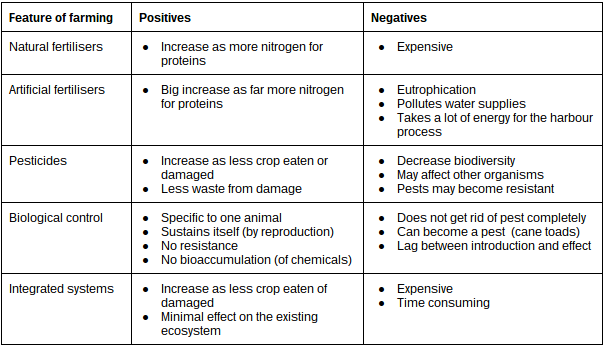
Eutrophication happens when water leeches nitrogen from soil and takes it into a water system: here the nitrogen helps algae to grow causing a bloom (large layer of algae); this blocks light for other organisms, like fish, and uses up their oxygen, causing them to die; decomposers increase as they feed on the dead, using up even more oxygen; oxygen is so low that no other organisms can survive.
Intensive farming also happens with livestock.
 1 Slaughtered when still growing/before maturity/while young
so more energy transferred to biomass/tissue/production;
2 Fed on concentrate /controlled diet /controlled
conditions/so higher proportion of (digested) food
absorbed/lower proportion lost in faeces / valid reason for
addition;
3 Movement restricted so less respiratory loss / less energy
used;
4 Kept inside/heating/shelter / confined so less heat loss / no
predators;
5 Genetically selected for high productivity;
In modern day farming energy is introduced to a system via feeding, heat and artificial light; this increase in input makes for an increase in out put, a higher yield.
Productivity is the amount of chemical energy that plants make by photosynthesis. The net is calculated by the amount of energy produced from photosynthesis take away the amount that is used by the plant during respiration.
Net productivity= gross production - respiratory loss
In modern day farming farmers use any means possible to increase their yield, and therefore increase their profit.
Natural fertilisers include manure and animal bone; things that naturally contain nitrogen. Artificial fertilizers contain nitrogen made by the harbour process and extracted from rocks.
Pesticides are chemicals that are spread on crops to kill pests (things that are eating or damaging crops). Biological control is the introduction of an organism that will eat a pest. An integrated system is a series of techniques used to try and keep pest damage to a minimum, without disturbing the biodiversity of an area e.g. choosing areas with few pests, encouraging natural predators to be around, removing but not killing pests.

Intensive farming also happens with livestock.
so more energy transferred to biomass/tissue/production;
2 Fed on concentrate /controlled diet /controlled
conditions/so higher proportion of (digested) food
absorbed/lower proportion lost in faeces / valid reason for
addition;
3 Movement restricted so less respiratory loss / less energy
used;
4 Kept inside/heating/shelter / confined so less heat loss / no
predators;
5 Genetically selected for high productivity;
Photosynthesis is the main route by which energy enters an ecosystem. Energy is transferred through the trophic levels in food chains and food webs and is dissipated. Quantitative consideration of the efficiency of energy transfer between trophic levels. Pyramids of numbers, biomass and energy and their relationship to their corresponding food chains and webs.
Ultimately, energy comes from the sun. So how does energy get into the food chain? from things than convert sunlight into stored chemical energy i.e. producers (things that carry out photosynthesis).
An animal will eat a plant to gain the energy, this animals is the primary consumer (first thing to eat) in a food chain. Some of the plant may not get eaten and some may not get digested meaning that the energy does not transfer from the plant to the animal.
Of the energy that is transferred to the animal some will be stored, but some will get used up for carrying out the processes of living (movement, homoeostasis*). This means that when a second animal eats this primary consumer it will only get a very small amount of energy from the original plant.
*a lot of energy is used up by warm blooded creatures (mammals and birds) because they use it to maintain their body temperature.
1 Some light energy fails to strike/is reflected/not of
appropriate wavelength;
2 Efficiency of photosynthesis in plants is low/approximately
2% efficient;
3 Respiratory loss / excretion / faeces / not eaten;
4 Loss as heat;
5 Efficiency of transfer to consumers greater than transfer to
producers/approximately 10%;
6 Efficiency lower in older animals/herbivores/ primary
consumers/warm blooded animals/homoiotherms;
7 Carnivores use more of their food than herbivores;
We can see how efficient an energy transfer is, or how much energy actually gets passed on, by looking at how much energy an animal took in and how much it gave out; this shows us how much energy is lost at that trophic level. So if you are given a food chain that asks you to calculate the efficiency of a transfer between a worm and a bird of prey, and the worm has 6500 (kjm-2year-1) of energy available and the bird has 1500 (kjm-2year-1) of energy avalible then:
Efficiency= energy after/energy before * 100
= 1500/6500 * 100
= 0.23 * 100
= 23%
Because energy is lost between levels, you might assume that there would always be fewer animals as you went up trophic levels as there is less energy. This would be the case in the food chain of algae, fish, bird:
However there are examples where this is not the case. If we look at a food chain surrounding a tree, often the organisms that feed off the tree are very small and the tree is very big, so one tree can feed many organisms:
A way to make sense of this is to use a pyramid of biomass. This is basically like saying the weight of the organisms on a level (this does not include the weight of water because it disrupts the figures; so dry mass). For this example if we weighed the tree, all the insects and all the birds, we would end up with something like this:
Pyramids of biomass are a much more reliable way of representing food chains, but in practice it is difficult to collect accurate data on the weight and number of organisms due to factors like seasonal change and movement.
Another problem with them is that there is a big difference between the energy stored in certain molecules; for example you may have a very heavy organism packed with carbohydrate that would have less energy than a lighter organism covered in fat. A way to get round this problem is to use a pyramid of energy which displays the amount of energy at each level:
An animal will eat a plant to gain the energy, this animals is the primary consumer (first thing to eat) in a food chain. Some of the plant may not get eaten and some may not get digested meaning that the energy does not transfer from the plant to the animal.
Of the energy that is transferred to the animal some will be stored, but some will get used up for carrying out the processes of living (movement, homoeostasis*). This means that when a second animal eats this primary consumer it will only get a very small amount of energy from the original plant.
*a lot of energy is used up by warm blooded creatures (mammals and birds) because they use it to maintain their body temperature.
1 Some light energy fails to strike/is reflected/not of
appropriate wavelength;
2 Efficiency of photosynthesis in plants is low/approximately
2% efficient;
3 Respiratory loss / excretion / faeces / not eaten;
4 Loss as heat;
5 Efficiency of transfer to consumers greater than transfer to
producers/approximately 10%;
6 Efficiency lower in older animals/herbivores/ primary
consumers/warm blooded animals/homoiotherms;
7 Carnivores use more of their food than herbivores;
We can see how efficient an energy transfer is, or how much energy actually gets passed on, by looking at how much energy an animal took in and how much it gave out; this shows us how much energy is lost at that trophic level. So if you are given a food chain that asks you to calculate the efficiency of a transfer between a worm and a bird of prey, and the worm has 6500 (kjm-2year-1) of energy available and the bird has 1500 (kjm-2year-1) of energy avalible then:
Efficiency= energy after/energy before * 100
= 1500/6500 * 100
= 0.23 * 100
= 23%
Because energy is lost between levels, you might assume that there would always be fewer animals as you went up trophic levels as there is less energy. This would be the case in the food chain of algae, fish, bird:
.jpg) |
| Pyramid of number |
.jpg) |
| Pyramid of number |
.jpg) |
| Pyramid of biomass |
Another problem with them is that there is a big difference between the energy stored in certain molecules; for example you may have a very heavy organism packed with carbohydrate that would have less energy than a lighter organism covered in fat. A way to get round this problem is to use a pyramid of energy which displays the amount of energy at each level:
|
| Pyramid of energy |
Glycolysis followed by the production of ethanol or lactate and the regeneration of NAD in anaerobic respiration.
The first stage of respiration is the same in aerobic and anaerobic respiration; glycolysis. This is because it does not involve oxygen so is not hindered if it is not present.
Two ATP are used to add phosphate groups to glucose, creating phosphorolated glucose. This splits into two molecules of triosephosphate which has phosphate removed by ADP and is reduced byv NAD to make pyruvate.
.jpg)
Two ATP are used to add phosphate groups to glucose, creating phosphorolated glucose. This splits into two molecules of triosephosphate which has phosphate removed by ADP and is reduced byv NAD to make pyruvate.
By doing these things the cell has a net gain of 2ATP and so has respired, but with a much lower energy yield than aerobic respiration.
Usually at this stage NADH would go on to the Krebs cycle, lose its hydrogen, and become NAD again, ready to take part in some more glycolysis. However there is no oxygen, so there is no Krebs cycle, this would mean that NAD was not avalible because it was all NADH.
To solve this problem the pyruvate takes the hydrogen from the NADH making it NAD again. Pyruvate and hydrogen can make one of two things: ethanol + carbon dioxide or lactic acid.
In some plants and in yeast ethanol and CO2 are produced, and in animals it's lactate.
Subscribe to:
Posts (Atom)